THE SOURCE
UV-C. Inside the cap.
Our cap concept uses ultraviolet-C LEDs directed into the closed bottle. The current engineering direction is approximately 270–280 nm; the final emitter and operating settings are still being evaluated.
WATER, IN A NEW LIGHT
A sculpted bottle. A rechargeable UV-C cap.
Developing a new water-treatment routine,
with everyday life in Nigeria in mind.
IN DEVELOPMENT · PERFORMANCE TESTING AHEAD
Helix in ivory selected.
A bottle you want to carry. A cap designed to do more.
UV-C technology, brought into an everyday object.
THE CONCEPT COLLECTION
Inspired by movement. Shaped for your day.
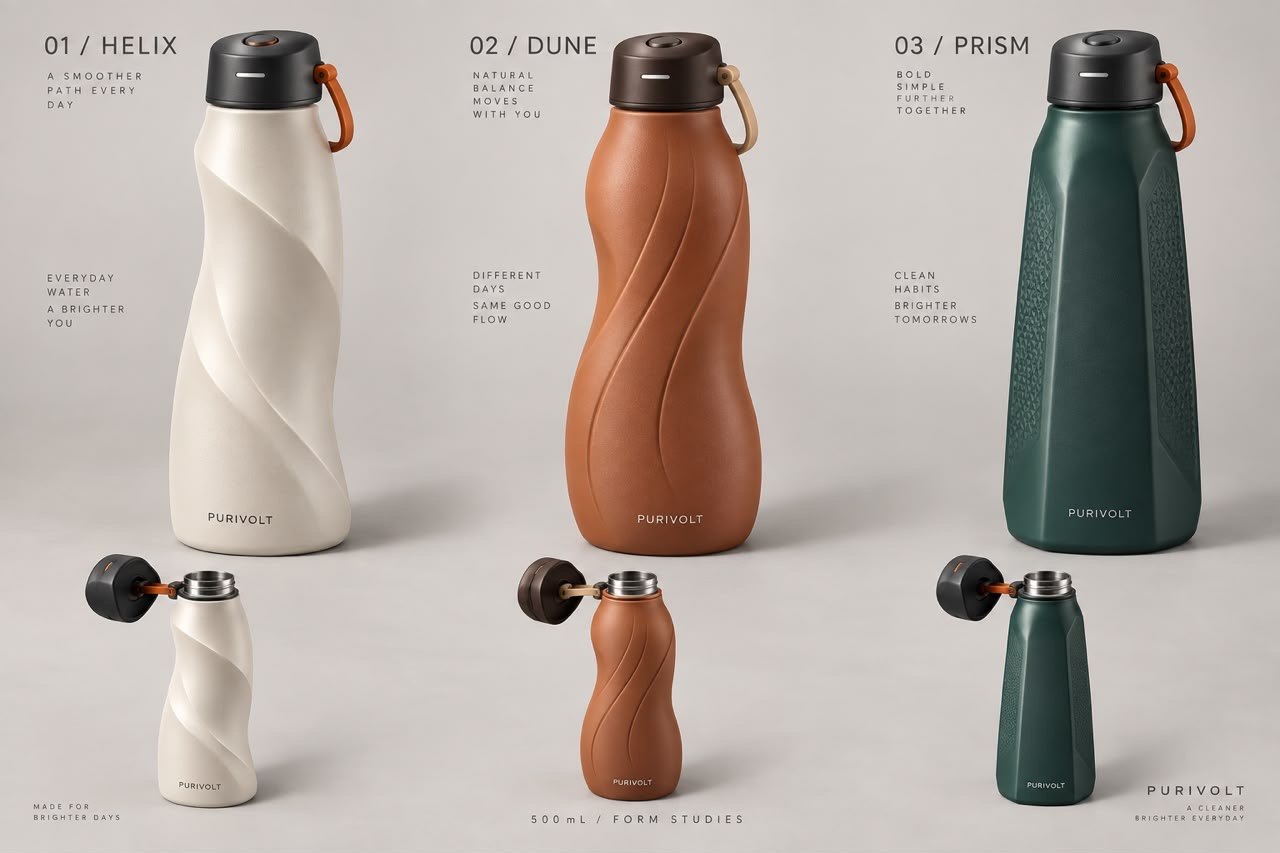
Explore our first 500 mL design studies.
Concept forms. Final materials, capacity and finishes may evolve.
Explore selected form in 3D02 / SMALL DETAILS. BIG INTENTION.
The intelligence lives in the cap.
We’re developing ours from the inside out.
A simple press to begin the intended treatment cycle.
A soft status indicator. The visible glow is not the UV-C treatment light.
UV-C LEDs, battery power and control, brought together in one cap.
An 8-second light animation, not a treatment timer or proof of safe water.
03 / THE TECHNOLOGY, EXPLAINED
Not a filter. Not just a glowing cap.
We’re developing UV-C LED technology
for microbial disinfection in a reusable bottle.
THE SOURCE
Our cap concept uses ultraviolet-C LEDs directed into the closed bottle. The current engineering direction is approximately 270–280 nm; the final emitter and operating settings are still being evaluated.
THE PRINCIPLE
UV-C can damage the genetic material of microorganisms, preventing them from reproducing. It needs sufficient exposure to work; it does not strain particles out of the water.
THE EXPERIENCE
The ambient rim is intended to show cycle status. It does not measure water purity or prove treatment success. UV shielding and a cap safety interlock are part of the design work still to be verified.
THE REACH. THE RESULTS. THE LIMITS.
The goal is to treat water throughout a compatible, filled bottle—not just at the surface. But UV-C has no single guaranteed “reach”: water clarity, bottle geometry, light output and exposure time all matter.
PURIVOLT’s coverage, cycle duration and microbial reduction are not yet validated. The 500 mL forms shown here are design targets, not a proven treatment capacity.
WHAT UV-C CAN TARGET
With an adequate dose, UV-C can inactivate bacteria, viruses and protozoa. This describes the technology—not a tested result for this product.
MICROBIAL DISINFECTIONWHAT THIS CAP DOES NOT DO
No physical filter is built into this concept. It does not remove dirt, salt, heavy metals or dissolved chemical pollution. Clear-looking water is not necessarily safe.
NOT AN ALL-WATER PURIFIERWHAT WE NEED TO PROVE
Testing must establish dose and coverage, suitable water conditions, cycle time and microbial reduction for the finished cap-and-bottle system.
RESULTS BEFORE CLAIMSGood water habits still matter. Cloudiness can shield microbes from UV. UV does not prevent later recontamination, and the bottle still needs regular cleaning. Do not rely on this unvalidated product to make unsafe water drinkable.
These explain UV treatment in general. They are not PURIVOLT test reports, approvals or endorsements.
04 / A LOCAL STARTING POINT. A WIDER AMBITION.
We’re starting with people in Nigeria: students, commuters, professionals and travellers who want a reusable bottle and a simpler water-treatment routine.
Access to safe water remains an important challenge, as UNICEF Nigeria’s WASH work highlights. We think thoughtful, portable technology can be worth exploring alongside the water services people depend on.
Nigeria is our first focus. Learning from people here—and adapting to different needs across Africa—is the longer-term ambition.
One cap, one button and clear status feedback. The aim is a treatment step that fits a day away from home, without a complicated setup.
A rechargeable battery is intended to run the cap away from a socket between charges. Real battery endurance will be established through testing.
Developing the cap in-house and sourcing the bottle are part of our cost-conscious approach. Affordability is a design goal; final pricing is not set.
A personal bottle cannot replace safe public water, appropriate filtration or sanitation. Our ambition is to contribute one useful part.
Help shape what comes next05 / FROM THE DESIGN DESK
What if the bottle you carried every day could do a little more?
Our answer starts with a cap designed in-house, paired with a bottle sourced from a manufacturing partner. These first studies explore how it all comes together.
Currently in development
Next: prototype testing, then performance validation. Launch details will follow what we learn.
BE PART OF OUR NIGERIA-FIRST JOURNEY
Follow the prototypes, the testing and what we learn.
Help shape a product for everyday life here.
A FEW THINGS YOU MAY BE WONDERING
We’re developing and testing the product, with Nigeria as our first market focus. A launch date, final price and other country availability have not been set. Join the waitlist for updates.
Helix, Dune and Prism are our first form studies. You can explore each here; final models and finishes will be announced after design and manufacturing validation.
The treatment duration is not yet established. It must be validated with the final UV-C emitter, water volume and bottle geometry. The 8-second website animation demonstrates the indicator light only—it is not a cleaning-time specification.
No. The visible rim is a proposed cycle-status indicator, not a water-quality sensor. It is separate from the UV-C emitter inside the cap. Product safety, shielding and the cap interlock still require verification.
A source’s name or clear appearance does not establish safety. This UV-C concept is not a filter and does not remove dissolved chemical contamination. We have not yet validated supported water conditions; do not use this unvalidated product to make an unsafe source drinkable. Follow local public-health guidance and use an established safe supply.
A defensible reduction claim needs microbiological testing of the finished system under defined conditions. We intend to publish the tested organisms, water conditions, volume, cycle duration and reduction results when those are available—not borrow results from another UV device.